
Lowboy vs RGN Trailer: Structural and Loading Differences Between Fixed and Removable Gooseneck Lowbeds
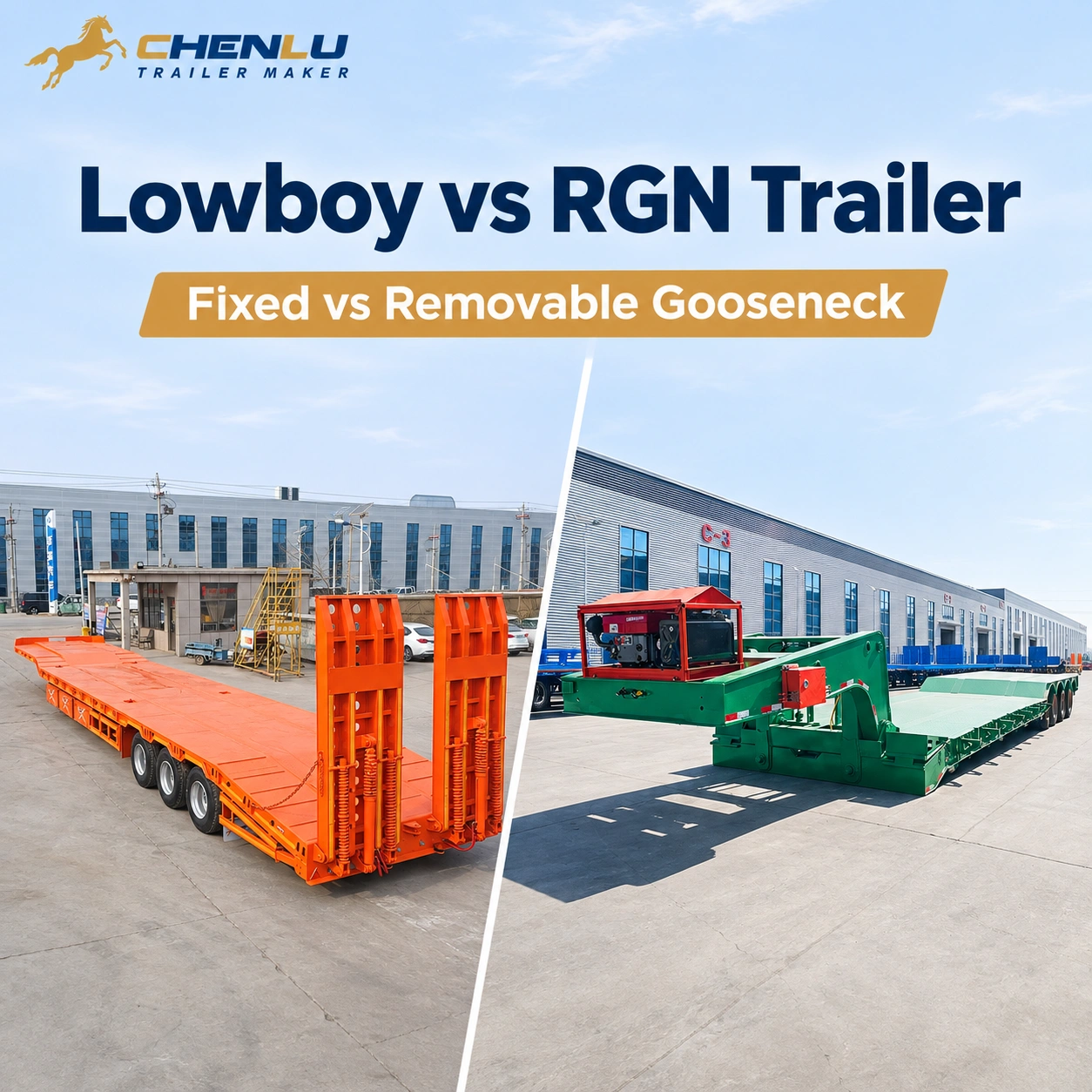
A lowboy is a heavy-haul semi-trailer with its main load deck lower than the front gooseneck and the rear axle platform. The name describes the low deck arrangement. It does not tell us how the gooseneck connects to the main frame.
RGN means Removable Gooseneck. On this trailer, the gooseneck can separate from the main deck. Once the neck is removed, the front of the deck becomes the loading entrance. This is why an RGN can be part of the lowboy family, while not every lowboy is an RGN.
The difference is easy to see in two CHENLU configurations:
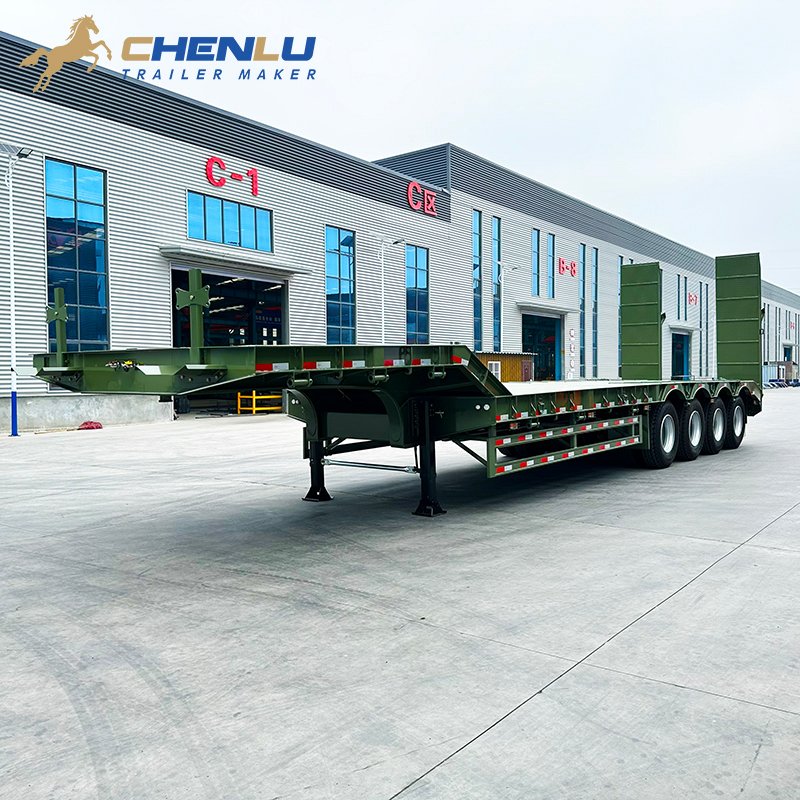
- The CHENLU four-axle fixed-gooseneck lowbed keeps its neck connected to the main frame. Equipment enters from the rear over two mechanical ramps.
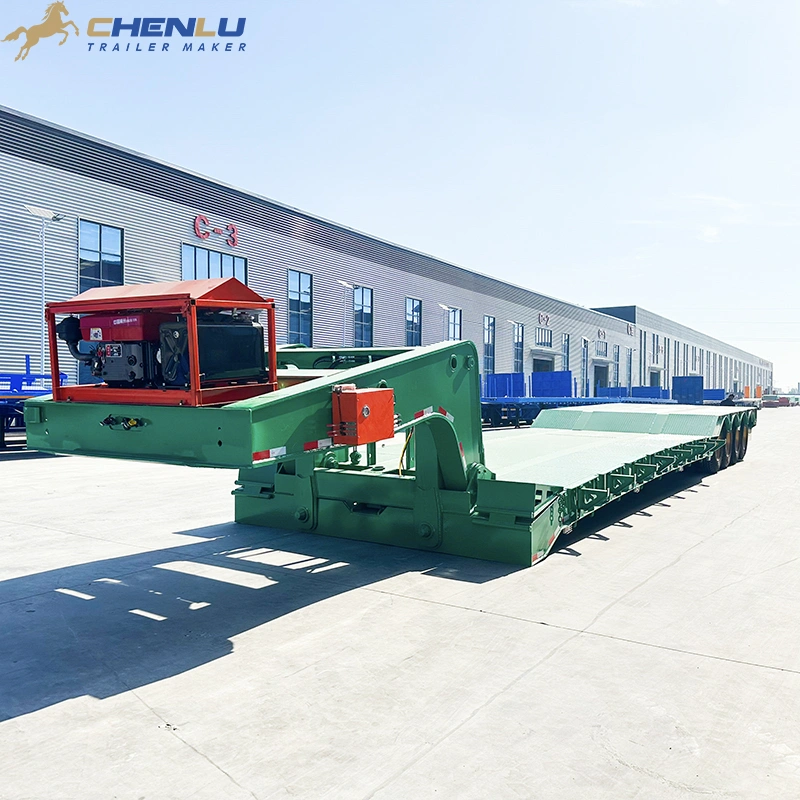
- The CHENLU four-axle removable-gooseneck lowbed lets the neck separate. Equipment enters from the lowered front end of the main deck.
These two trailers may have a similar low deck and a similar axle count. Their loading path, tractor movement, ground requirement and maintenance points are still different.
How Are Lowboy and RGN Trailers Related?
Lowboy is a broad vehicle name. In North America, it usually refers to a semi-trailer with a low main deck for moving construction machines and other tall or heavy equipment. In many export markets, the same general family may be called a low bed trailer, lowbed semi-trailer or low loader.
These names tell us where the main load deck sits. They do not fully define the front connection. A lowboy can use a fixed gooseneck, a folding gooseneck or a removable gooseneck. Some lowbed trailers also use an extendable main deck.
RGN is more specific. It names the gooseneck mechanism. The neck can disconnect from the main deck so the machine can approach from the front. For this reason, a product may be described as an RGN lowboy, a removable-gooseneck lowbed, or a detachable-gooseneck low loader. The wording changes with the market, but the connection method is the point that must be checked.
| Trailer arrangement | Part of the lowboy family? | Can the gooseneck separate? | Normal loading entrance |
|---|---|---|---|
| Fixed-gooseneck lowbed | Yes | No | Rear ramps |
| Folding-gooseneck lowbed | Yes | No; the neck changes position but stays attached | Front or rear, depending on the design |
| RGN lowboy | Yes | Yes | Front of the main deck |
What Is Different in the Gooseneck Connection?
On a fixed-gooseneck lowbed, the neck and the main frame stay connected during loading, transport and unloading. The tractor normally remains coupled. The gooseneck transfers load between the kingpin area and the main frame, while rear ramps provide access to the deck.
The CHENLU fixed-gooseneck model uses a fixed front connection, a low main deck and two spring-assisted mechanical ramps. The springs help an operator raise or lower the ramps. They do not change the ramp rating, trailer payload or loading angle.
On an RGN, the neck-to-deck connection is made so it can be released. The California Department of Transportation permit manual describes a removable gooseneck as a gooseneck that can be removed from the trailer deck. This definition is useful because it separates the mechanism from the wider lowboy name.
The CHENLU RGN also travels with the gooseneck connected. The neck is removed only for the loading or unloading operation. After the machine reaches its transport position, the neck is reconnected and locked before road travel.
So the basic structural difference is not deck height or axle number. It is whether the connection between the gooseneck and main deck can be released as part of the loading process.
How Does the Loading Direction Change?
Rear loading on a fixed-gooseneck lowboy
A fixed-gooseneck lowboy uses the rear of the trailer as its main entrance. A tracked or wheeled machine usually passes through five areas:
- the ramp foot on the ground;
- the ramp slope;
- the top of the ramp;
- the rear platform above the axle group; and
- the transition down to the main low deck.
The machine must clear each change in angle. Track length, wheelbase, ground clearance, overhang and the position of low parts under the machine all matter. Ramp width and spacing must also match the tracks or tyres. A machine can fit the deck width but still fail to cross the rear transition.
Front loading on an RGN lowboy
An RGN changes the entrance. The gooseneck separates, the tractor moves clear, and the front of the main deck is lowered into its loading position. The machine then moves onto the deck from the front.
Front loading removes the need to climb over a raised rear axle platform. It does not mean the route is flat. The machine still has to clear the deck nose, ground contact point and any change in angle as the deck rises from the ground. Firm and level ground is also important because the front of the trailer needs support during the operation.
How Do Equipment Clearance Requirements Differ?
Tracked equipment on a fixed-gooseneck trailer
For an excavator, bulldozer or crawler machine, the first check is not only machine weight. The track contact length and the lowest point under the chassis affect whether the machine can pass the ramp crest and rear deck transition.
Long tracks can bridge a short change in angle, but a low belly guard, counterweight or attachment may still touch the trailer. The ramp spacing must support both tracks. If one track is partly outside the ramp path, the machine can load unevenly before it reaches the deck.
Tracked equipment on an RGN trailer
An RGN gives a more direct path to the main deck. This often suits machines with low ground clearance or a long track frame. The front entry still needs enough width and a suitable approach angle. The machine must also stop at the correct fore-and-aft position so its weight is shared between the kingpin and rear axle group.
Wheeled machines and long wheelbases
For a wheel loader, grader or crane, wheelbase and overhang can be more important than track length. A long wheelbase may bridge one transition but touch another. Front and rear overhang must be checked while the machine is still on the loading slope, not only after it is parked on the deck.
The same clearance logic is covered in more detail in How to Load Heavy Equipment on a Lowboy Trailer.
Where Do Local Loads Occur During Loading?
During rear loading, a fixed-gooseneck trailer receives concentrated loads through the ramps. The load passes through the ramp surface, internal reinforcement, hinges and rear frame before it reaches the suspension and ground. Ramp condition and hinge locking therefore matter even when the machine weight is within the trailer's general capacity range.
Spring assistance only reduces the effort needed to move the ramps. It does not carry the machine. The ramp structure and its attachment points still take the loading force.
On an RGN, the critical loading area moves to the front of the main deck and the removable connection. The front support point, deck nose and ground below the trailer must remain stable while the neck is detached. The tractor must also be aligned correctly when the neck reconnects.
The Talbert Trailers operator's manual calls for loading and unloading on firm, level ground and keeping the truck and trailer in a straight line. This is a general operating reference. The exact steps for a CHENLU RGN must follow the operating document supplied with that trailer.
What Loading-Site Space Does Each Trailer Need?
A fixed-gooseneck lowboy needs a straight approach behind the trailer. The site should allow room for the full ramp length, the machine to line up, and the operator to correct the approach before climbing. Soft ground under the ramp feet can change the ramp angle and load path.
An RGN needs working space around the tractor and front of the trailer. The tractor has to move as part of the neck removal and reconnection process. The ground must support the lowered front deck and let the machine approach in a straight line.
The loading site and unloading site should be checked separately. A trailer may load easily at a factory yard but face a narrow gate, uneven ground or limited turning room at the destination.
How Does the Tractor Work With Each Trailer?
With a fixed-gooseneck lowboy, the tractor usually remains coupled throughout loading. The driver positions the combination, applies the required brakes and keeps the trailer straight while the equipment moves over the rear ramps.
With an RGN, the tractor is part of the loading sequence. A normal sequence includes:
- parking the trailer on firm, level ground;
- releasing the neck locking system according to the operating procedure;
- moving the tractor and gooseneck clear of the main deck;
- loading the machine from the front;
- returning the tractor and gooseneck to the deck;
- reconnecting, locking and checking the mechanism.
Some systems use hydraulic power and others use a different mechanical arrangement. Fifth-wheel height, tractor connection, hydraulic lines and control method must match the ordered trailer. The letters RGN alone do not define all these details.
Does an RGN Change Load Distribution During Transport?
Both trailers travel with the gooseneck connected. In road position, the machine's fore-and-aft location affects the load transferred to the kingpin and the load carried by the rear axle group.
The final loading position depends on machine weight, centre of gravity, deck length, axle spacing, axle and suspension ratings, tyre capacity and the tractor's fifth-wheel load. Moving the machine only a short distance can change the reactions at both ends of the trailer.
An RGN does not automatically have a higher payload, a lower deck or better load distribution than a fixed-gooseneck lowboy. Those results come from the complete frame, axle, suspension and load plan, not from the removable neck by itself.
How Do Maintenance and Price Components Differ?
A fixed-gooseneck lowboy has fewer moving parts at the front. Its regular checks focus on the rear ramps, springs or hydraulic parts where fitted, hinge pins, ramp locks, welds and rear frame condition.
An RGN adds a removable connection and its related operating system. Inspection normally includes connection surfaces, locking points, pins, hydraulic components where fitted, hoses, controls and alignment between the neck and main deck.
This extra mechanism is one reason an RGN can cost more than a fixed-gooseneck trailer of a similar general size. Price is also affected by axle count, axle rating, frame structure, deck length and width, suspension, tyres, braking equipment and order-specific options. A price comparison is useful only when these items are placed in the same scope.
CHENLU Four-Axle Fixed-Gooseneck and RGN Examples
CHENLU builds both structures within its low bed trailer range. The two four-axle examples show how the loading route changes even when the running gear has the same axle count.
| Comparison point | Four-axle fixed-gooseneck lowbed | Four-axle RGN lowboy |
|---|---|---|
| Gooseneck during loading | Stays connected | Separates from the main deck |
| Main equipment entrance | Rear ramps | Front of the lowered main deck |
| Main slope source | Rear ramps and rear deck transition | Front deck approach and ground contact |
| Tractor position | Usually remains coupled | Moves during neck removal and reconnection |
| Important clearance checks | Ramp crest, rear platform and transition to low deck | Front approach, deck nose and loaded position |
| Site space | Clear approach behind the trailer | Working room for tractor and front loading |
| Extra moving connection | No removable front connection | Neck locking and operating system |
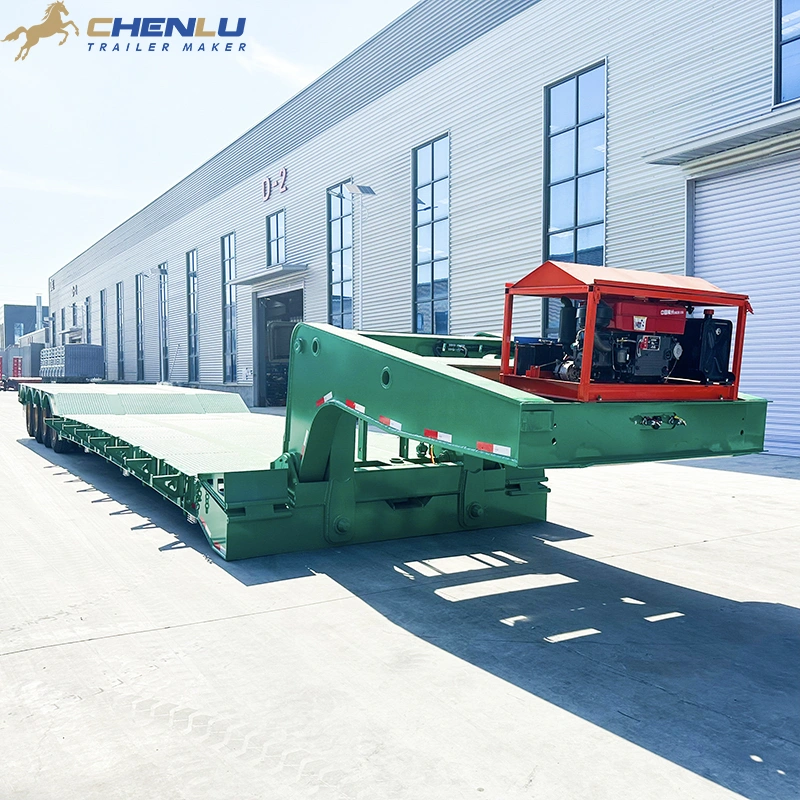
The CHENLU fixed-gooseneck model uses rear mechanical ramps. The CHENLU four-axle RGN uses a removable front gooseneck. More removable-neck configurations are listed in the removable gooseneck trailer range.
The same axle count does not mean the two trailers have the same payload, deck size or axle ratings. Those items must be taken from the quotation and approved order drawing for the exact build.
When Does Each Structure Fit the Transport Job?
A fixed-gooseneck lowboy is suitable when the machine can safely cross the rear ramps and deck transitions, and when the site has enough straight space behind the trailer. The simpler front structure can also reduce the number of removable connection parts that need inspection.
An RGN becomes useful when the machine needs a front loading path. This often applies to equipment with low ground clearance, a long track frame or limited ability to cross a rear axle platform. It is also useful when rear access is difficult but the site has enough room for the tractor and removable neck operation.
Neither structure makes every machine self-loading. Equipment that cannot move under its own power may still need a winch, crane or another loading method.
A proper comparison should cover four groups of information:
- Machine: transport weight, overall dimensions, track or tyre spacing, wheelbase, ground clearance, centre of gravity and ability to move under its own power.
- Trailer: deck length and width, loading height, ramp or front-entry geometry, axle layout, suspension, tyres and approved load plan.
- Site: ground bearing condition, approach direction, working space, slope, gate width and unloading access.
- Tractor and route: fifth-wheel height, kingpin load, hydraulic connection where required, route limits and local permit conditions.
Frequently Asked Questions
Is an RGN a type of lowboy trailer?
Yes. An RGN can be part of the lowboy family because it uses a low main deck. RGN specifies that the gooseneck can separate from the main deck.
What is the main difference between a fixed lowboy and an RGN?
The fixed-gooseneck trailer keeps its neck attached and usually loads from the rear. An RGN removes the neck and normally loads from the front.
Are RGN and detachable gooseneck the same?
They are commonly used for the same general mechanism. The contract should still describe how the neck disconnects, locks and operates because the exact system can differ.
Is a folding gooseneck an RGN?
No. A folding gooseneck changes position but remains connected to the main trailer. An RGN separates from the main deck.
Does an RGN need no ramps?
An RGN may not need rear loading ramps, but the front deck still forms an approach from the ground. Some equipment or site conditions may need extra support or another loading aid.
Does an RGN always carry more weight?
No. Payload depends on the frame, axle and suspension ratings, tyres, load position and the approved load plan. The removable gooseneck mainly changes the loading method.
Should an excavator use a fixed lowboy or an RGN?
Either may work. Check the excavator's transport weight, track dimensions, ground clearance and approach geometry against the trailer. An RGN is often easier when the excavator cannot safely cross the rear ramp and axle-platform transitions.
Conclusion
Lowboy and RGN are not two equal vehicle names. Lowboy describes the wider low-deck trailer family. RGN describes a removable gooseneck structure inside that family.
A fixed-gooseneck lowboy loads over rear ramps and keeps the tractor connected. An RGN opens the front of the main deck and needs the tractor to take part in removing and reconnecting the neck. This changes the machine's path, the ground and space needed at the site, and the parts that require inspection.
The right structure depends on how the actual machine reaches the deck and where its weight sits after loading. That should be checked from the machine data, site conditions, tractor and route, then written into the quotation and approved drawing.
References
MORE FROM OUR NEWSROOM
Related News
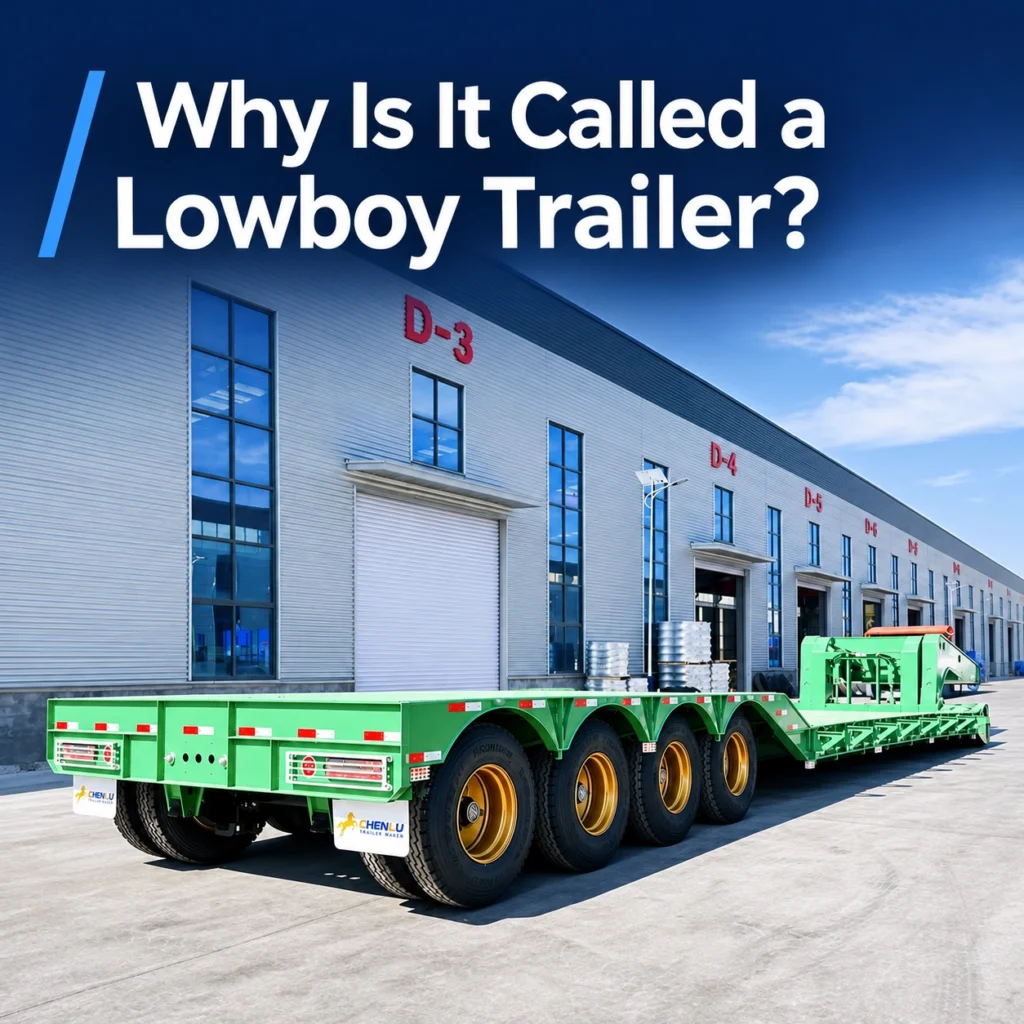
Why are low-platform semi-trailers called “Lowboys”? What is the difference between a “Lowboy,” a “Low Bed,” and a “Low Loader”?
Why is it called a lowboy trailer? Learn how lowboy, low bed, low loader, cama baja and regional terms relate to deck and gooseneck design.
Read News ↗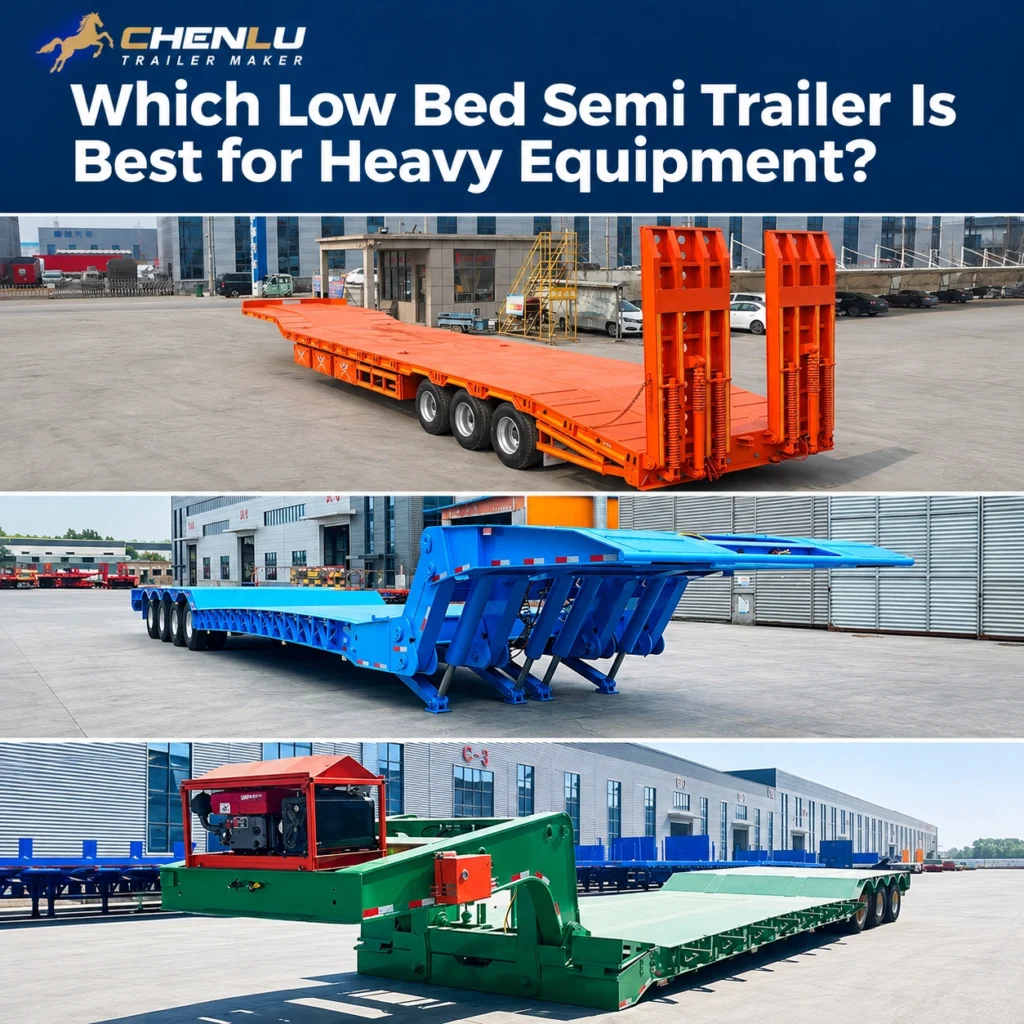
Which Low Bed Semi Trailer Is Best for Heavy Equipment? Fixed, Folding and Detachable Goosenecks
Compare fixed, folding and detachable gooseneck low bed semi trailers for heavy equipment, including loading access, CHENLU dimensions, axle layouts, tractor matching and route checks.
Read News ↗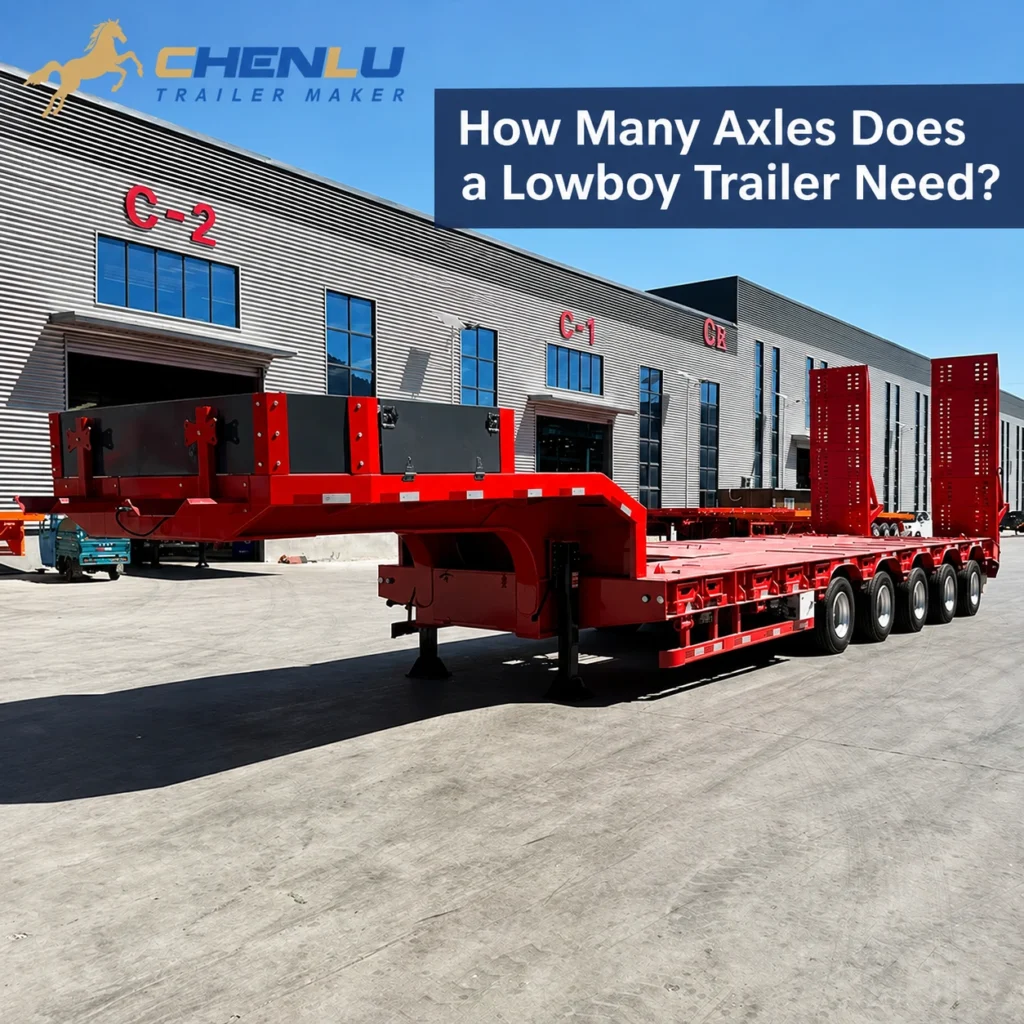
How Many Axles Does a Lowboy Trailer Need? 2-, 3-, 4- and Multi-Axle Configurations
A lowboy trailer may have 2, 3, 4 or more axles. Compare low bed semi trailer axle configurations by cargo weight, axle spacing, tractor and route limits.
Read News ↗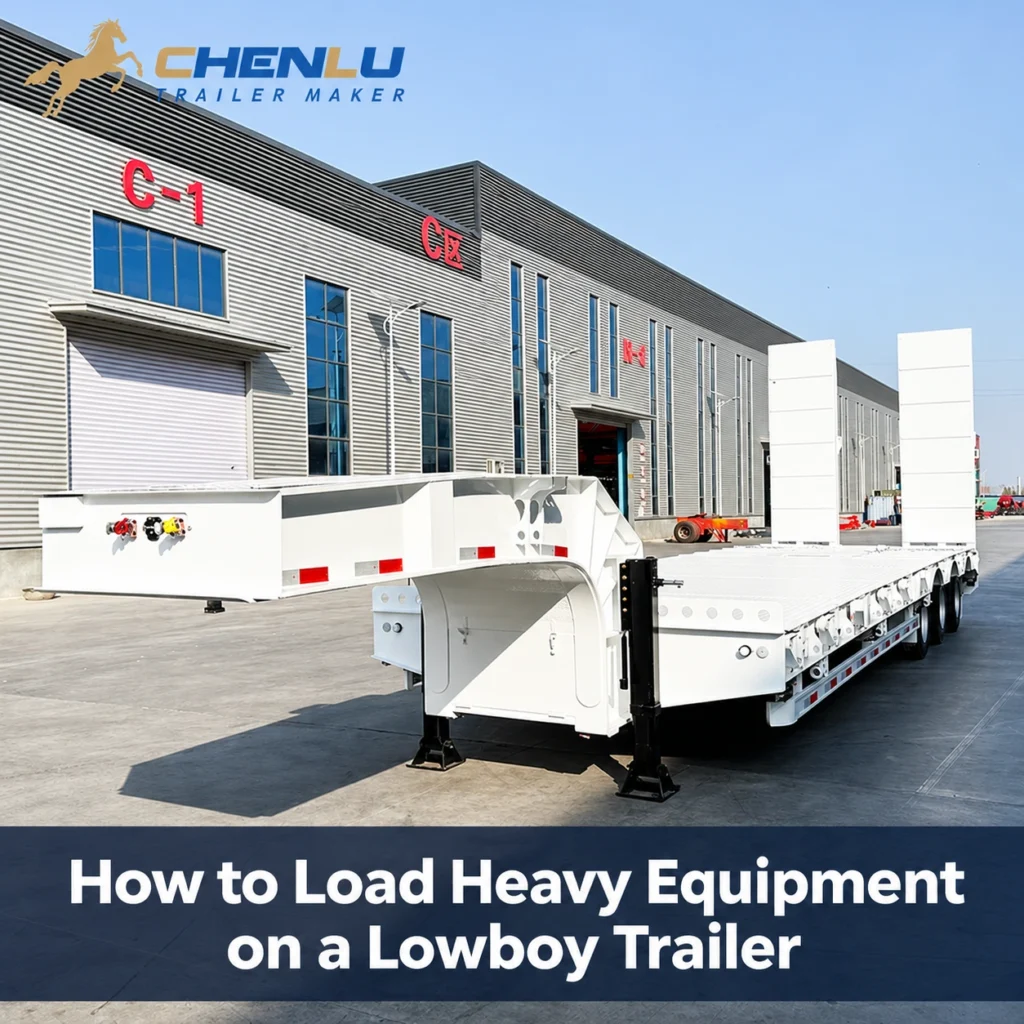
How to Load Heavy Equipment on a Lowboy Trailer: Rear Ramps, Folding Goosenecks and RGN
This lowboy trailer loading guide compares rear ramps, folding and detachable goosenecks for heavy equipment, including loading angle and ground clearance.
Read News ↗
What Is a Lowboy Trailer Used For? Equipment, Loading Methods and Trailer Selection
What is a lowboy trailer used for? See how a heavy equipment lowboy trailer carries excavators, bulldozers, loaders and construction machinery.
Read News ↗
What Are the Dimensions of a Low Bed Semi Trailer? Overall Length, Deck Length, Width and Deck Height
Compare low bed semi trailer length, usable deck length, width and deck height using CHENLU fixed, folding, detachable and extendable gooseneck configurations.
Read News ↗