
Container Chassis vs Flatbed: Which Fits Your Container Layout and Return Cargo?
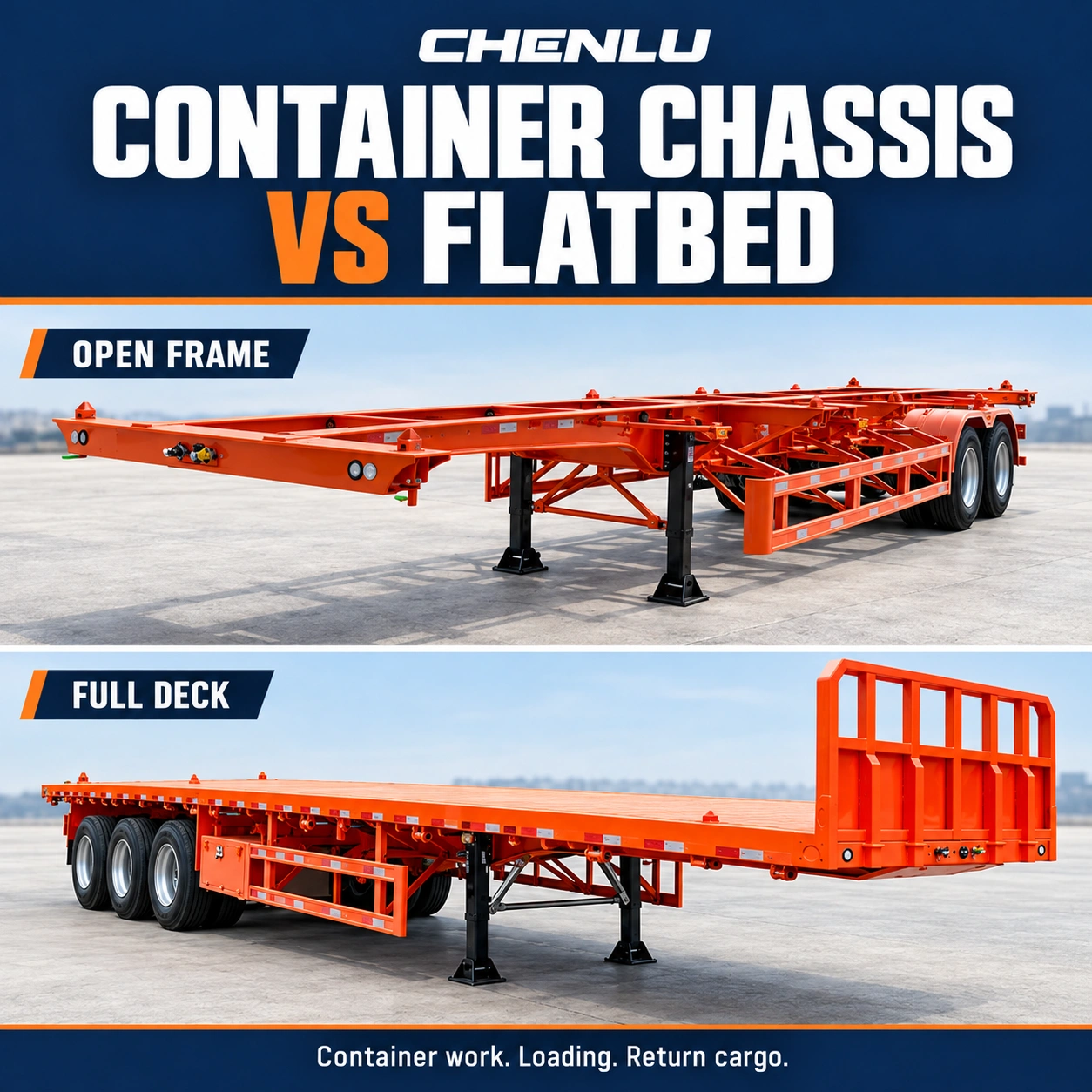
After delivering a 40 ft container to a warehouse, will the trailer take another container back to the port, or carry steel on the return trip? The outbound container may be the same, but a different return load changes what the trailer needs to do. The comparison between a chassis and a flatbed starts with that return trip.
For regular trips carrying whole containers in both directions, start by comparing dedicated container chassis. If the trailer must carry steel, pipe bundles or crates after the container is removed, consider a flatbed with the appropriate container locks. Both options must meet the support, locking and load requirements of the intended container. A full deck alone does not establish compatibility.
How Do the Two Trailers Support the Same Container?
A CHENLU skeletal container semi-trailer has an open frame, without a full deck for general freight. The container rests on its designed support positions, and its bottom corner fittings connect to the trailer locks. The frame transfers the load to the kingpin and rear axle group.
A flatbed semi-trailer has a continuous deck. Steel, pipe bundles and packaged freight can rest on it with supports suited to each load. A flatbed used for container transport also needs supports and locking devices that match the container's corner fittings.
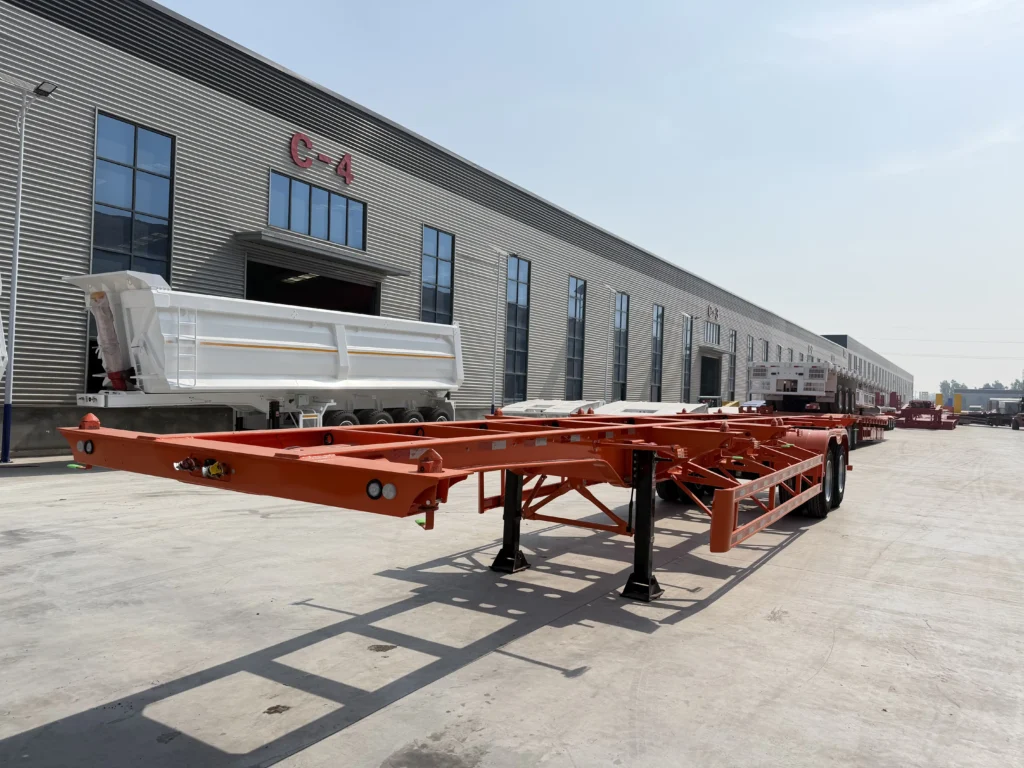
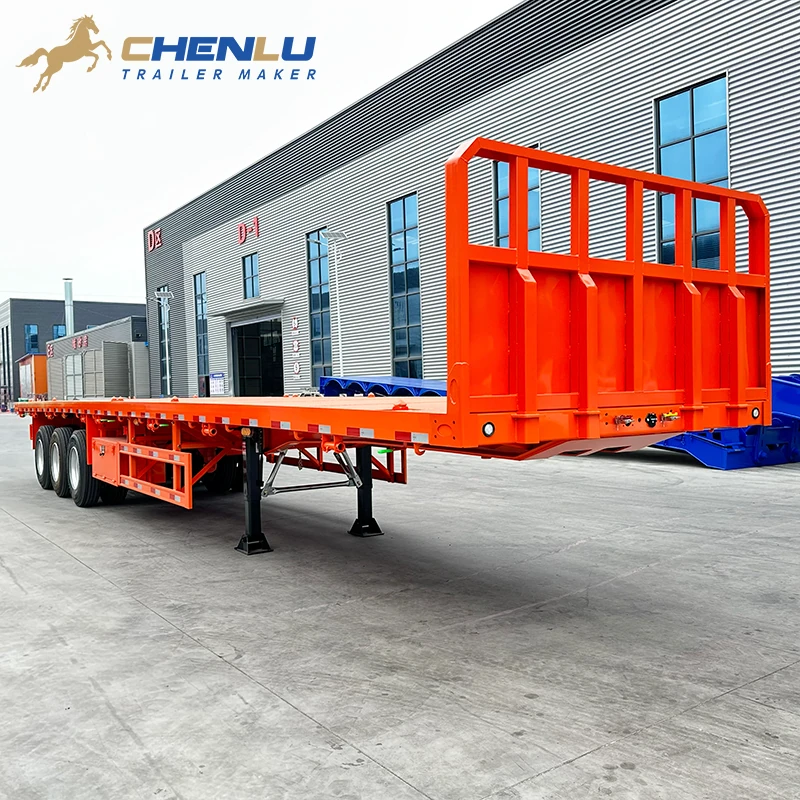
The difference is whether the trailer also needs to carry freight directly on its deck. For whole-container transport, do not assume that dunnage can be placed anywhere beneath the box. Nor should its entire underside be treated as a load-bearing support surface. The CTU Code recommends purpose-built container chassis that support the container through its four bottom corner fittings and connect to it with the appropriate twistlocks. [1]
| Comparison | Skeletal container chassis | Flatbed configured for container transport |
|---|---|---|
| Load-carrying structure | Open frame with supports at the specified container positions | Full deck, with supports and locks at the specified container positions |
| Container compatibility | Check corner positions, locks and permitted loading layouts | Check the same corner positions, locks and permitted loading layouts |
| Carrying steel, pipe bundles and similar freight directly | The open frame cannot serve as a general cargo deck | Supports, dunnage and restraints can be arranged to suit the cargo |
| Loading and unloading a whole container | Requires equipment suited to the container and its mass | Requires the same; the deck does not unload the container by itself |
| Tare weight | No full deck, but actual tare depends on the model | Includes the deck structure; compare actual weights for the same operating requirements |
Claims that a chassis will always carry a certain number of extra tonnes, or that a flatbed will always use more fuel, cannot be established from appearance alone. Axle count, frame structure, tyres, accessories and permitted loads affect the comparison. First compare two trailers intended for the same transport task, then assess their actual tare weights and available payloads.
One 20 ft, One 40 ft and Two 20 ft Containers Need Different Layouts
The table below gives external dimensions for common general-purpose containers. These dimensions identify the container size. They are not trailer lock spacings or usable deck dimensions. [2]
| Container type | External length | External width | External height |
|---|---|---|---|
| 20 ft standard-height dry container | 6,058 mm | 2,438 mm | 2,591 mm |
| 40 ft standard-height dry container | 12,192 mm | 2,438 mm | 2,591 mm |
| 40 ft high-cube container | 12,192 mm | 2,438 mm | 2,896 mm |
The combined external length of two 20 ft containers is 12,116 mm, which is 76 mm shorter than a single 40 ft container at 12,192 mm. This external-length calculation shows why the two arrangements cannot simply be treated as the same long box. The 76 mm difference is not an installation gap or a lock-spacing dimension. Actual positions depend on corner-fitting centres, the gap between containers and the trailer design. [3]
A single 40 ft container needs supports and locks at the positions specified for that container. When carrying two 20 ft containers, each box needs its own complete support and locking arrangement. The middle of the frame also needs the corresponding structure. Locks at the two ends of a 40 ft container position do not establish compatibility with two 20 ft containers.
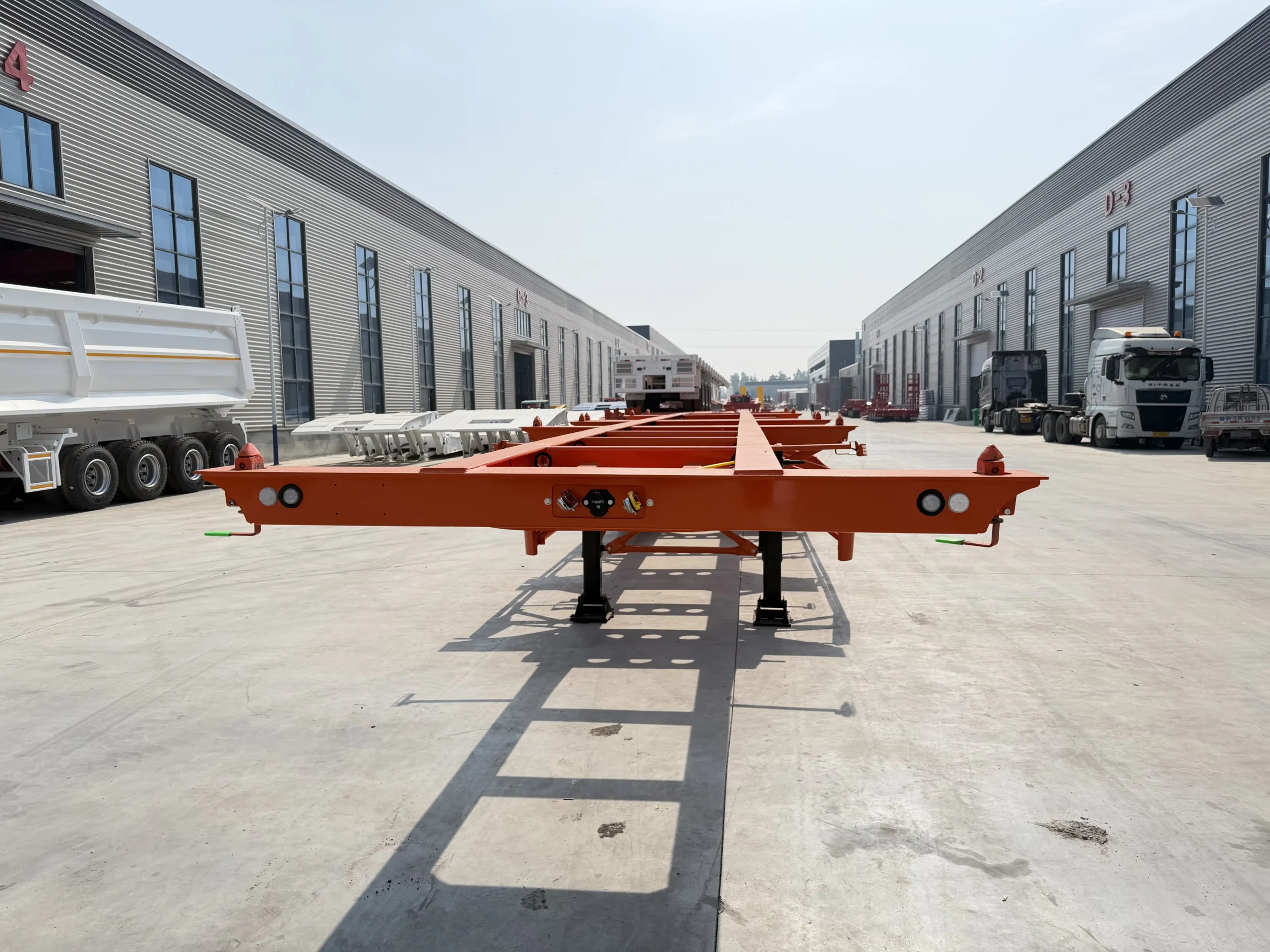
A single 20 ft container raises another question: where will it sit? Some models have a central position, some offer a position flush with the rear, and others have adjustable structures. For both chassis and flatbeds, check the permitted layouts. Sufficient overall trailer length does not mean the container can be placed anywhere.
A Shorter Box Is Not Necessarily Lighter: Position Affects Load Distribution
A 20 ft container is about half the length of a 40 ft container, but its mass does not decrease in the same proportion. Hapag-Lloyd's specification booklet lists a maximum gross mass of 32,500 kg for some examples of both 20 ft and 40 ft general-purpose containers. Gross mass includes the container and its contents. It is neither net cargo mass nor the trailer's permitted road payload. [2]
This matters for both trailer types. Heavy cargo inside a 20 ft container places the load within a shorter section of the frame. Moving the container forwards or backwards changes how the load is shared between the kingpin and rear axle group. Adequate frame strength does not, by itself, mean that every tractor and trailer axle is carrying an acceptable load.
If goods are concentrated at one end of the container, its centre of gravity may also sit away from its geometric centre. The CTU Code therefore calls for assessing available payload against the vehicle's own load-distribution diagram, rather than checking total cargo mass alone. [1]
A chassis has specified container positions that define where the box can sit. A flatbed provides more space for arranging general freight. That space does not allow a container to be moved freely along the deck. For either option, assess the loaded container mass, internal load distribution, permitted position and matching tractor under the same operating conditions.
Compare Loaded Height When Carrying a 40 ft High Cube
A 40 ft high cube has the same external length and width as a standard-height 40 ft container. Its external height increases from 2,591 mm to 2,896 mm, a difference of 305 mm. That extra height contributes directly to the loaded vehicle height. [2]
Consider an illustrative assumption: the support surface beneath the bottom corner fittings is 1,400 mm above the ground. The estimated loaded height is then 3,991 mm with the standard-height container, or 4,296 mm with the high cube. These are geometric calculations using an assumed support height. They are not measured heights for a CHENLU model or route clearance limits.
When comparing a chassis with a flatbed, use the actual container support height for the matched tractor, suspension condition and loading state. A flatbed's lock supports may stand above its deck. Chassis also use different frame designs. The absence of a deck alone does not establish that a particular chassis will be lower.
For a height-restricted route, compare the two candidate trailers carrying the same high-cube container. Check their loaded heights against the available clearance at bridges, tunnels and site entrances. Comparing empty trailer heights would miss the effects of the container and its support positions.
Loading Equipment and Return Cargo Determine Whether the Full Deck Is Useful
When a whole container is lifted onto or off a trailer at a port or yard, both trailer types need equipment suited to that container and its mass. Examples include a crane with a suitable container spreader or a reach stacker. A flatbed's side access for loading steel does not mean an ordinary cargo forklift can remove a loaded container. The CTU Code distinguishes container lifting methods by container type, empty or loaded condition, and lifting connections. [1]
Another operation leaves the container on the trailer while warehouse equipment removes the goods through its doors. Check how the container doors align with the loading dock, the means of bridging the gap and the equipment available. A container position flush with the rear may improve access to the doors, but it must also meet load-distribution requirements. KRONE's original equipment information lists rear-flush and central 20 ft positions and their associated structures separately. Those arrangements apply to its specific models and cannot be transferred directly to another trailer. [4]
A flatbed's full deck becomes useful for other cargo once the container is removed. Once the deck is clear, it can be considered for pipe bundles, steel sections or packaged freight. If only the contents have been unloaded and the container remains on the trailer, the full deck is still occupied.
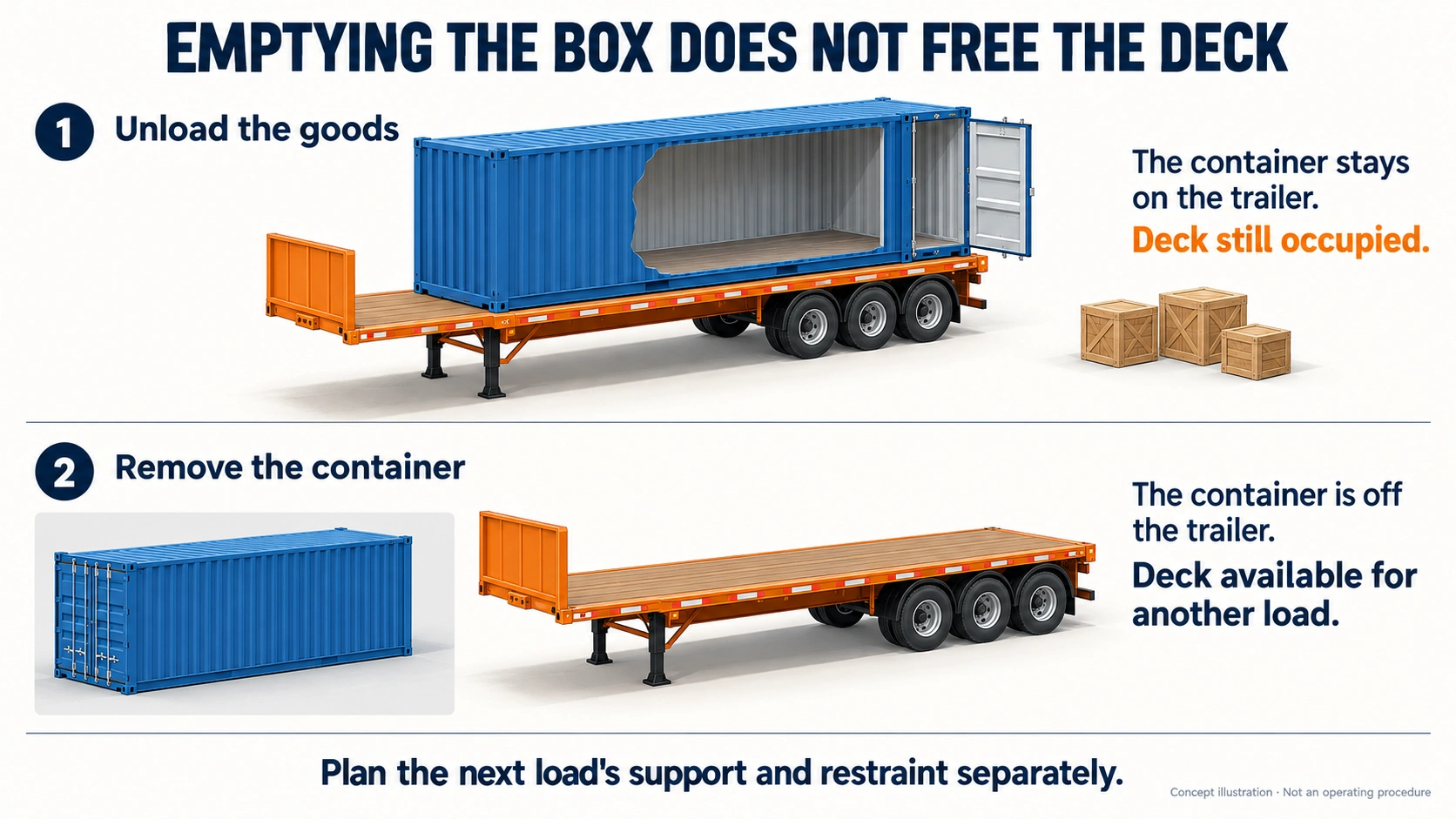
General freight on the return trip also needs its own support and restraint arrangement. Pipe bundles need restraint against rolling. Crates require suitable base support and consideration of their centre of gravity. Steel sections need appropriate dunnage, contact positions and restraints. Container locks connect to container corner fittings; they do not replace restraints for these loads. The CHENLU three-axle flatbed described above has a full deck and container locks, with no upright side stakes. Its fixed front headboard does not replace cargo tie-downs. CHENLU three-axle flatbed structure
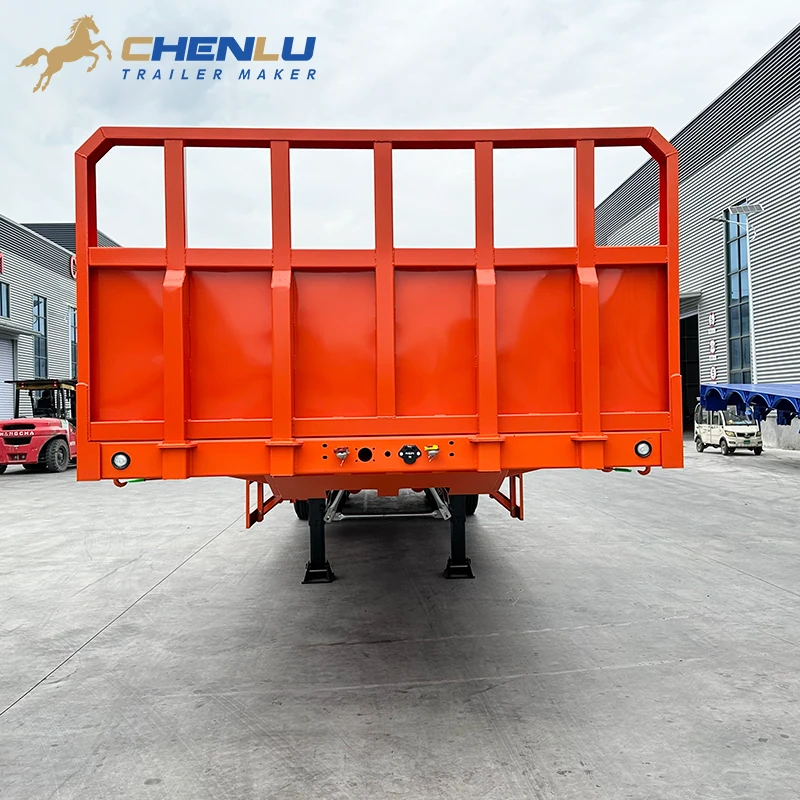
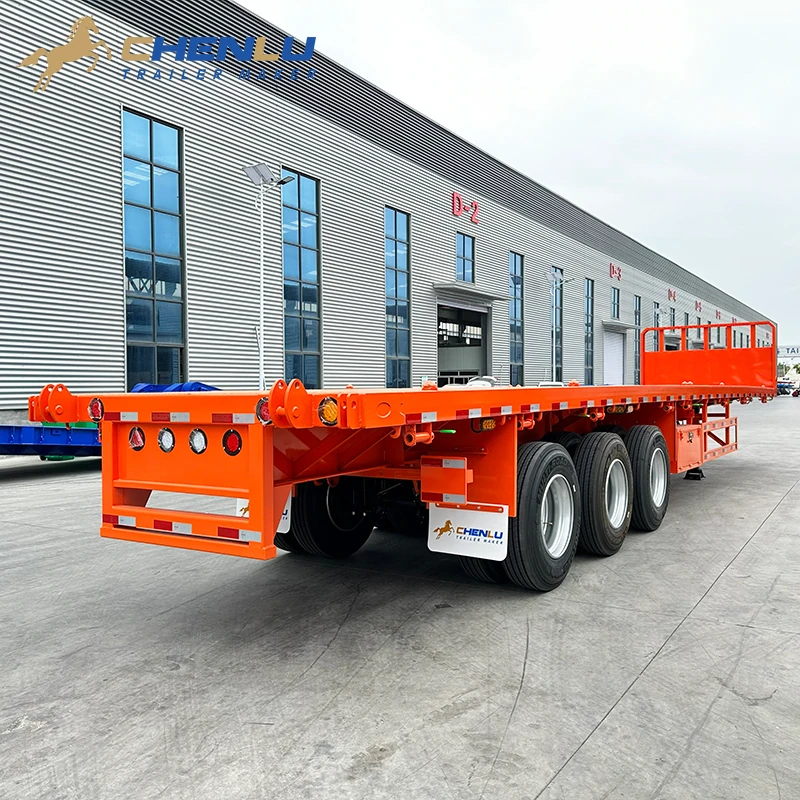
The value of a flatbed for mixed freight depends on a workable return plan: where the container is removed, where the next load is collected, whether loading and unloading can be completed, and whether the deck and anchorage points suit that cargo. A possible general freight load alone does not establish that a full deck will improve trailer utilisation.
Frequently Asked Questions
Can an Ordinary Flatbed Be Converted for Containers by Adding Twistlocks?
The conversion involves more than adding a few locks. Loads must pass through the twistlocks, their mountings and the frame. Corner-fitting support, container clearance, load distribution and modification requirements also need attention. The vehicle manufacturer should assess the specific arrangement. A full deck does not establish that the original structure is suitable for loads applied at container corner fittings.
Can Steel Plates on a Skeletal Chassis Replace a Flatbed for Return Cargo?
Temporary plates should not be treated as a cargo deck. An added platform changes tare weight and the load path. It also requires defined cargo support positions, local load capacity and anchorage points. For regular general freight work, compare flatbeds designed for that task. If a conversion is needed, have the manufacturer assess the structure.
Does Cargo Inside a Locked Container Still Need Securing?
Yes. Trailer locks connect the container to the semi-trailer; they do not restrain the goods inside. Internal loading still needs suitable support, consideration of the centre of gravity, and measures against sliding and tipping. The CTU Code addresses these separately in its packing and cargo-securing guidance. [1]
Match the Choice to the Actual Transport Task
If both outbound and return trips involve whole containers, compare CHENLU chassis by their regular container positions, loaded-container weight distribution and loading arrangements. If the trailer frequently carries steel, pipe bundles or packaged freight after the container is removed, include the CHENLU flatbed's deck, supports and restraints in the comparison.
When selecting a model, send CHENLU the two loads from a typical round trip: the outbound container type and loaded mass, plus the return cargo's dimensions, mass and loading method. Include the actual tractor and route conditions. This makes it possible to compare configurations for both trips and gives a practical basis for deciding whether the full deck is needed.
References
- IMO/ILO/UNECE: CTU Code, 2014 edition, MSC.1/Circ.1497 — Container support and locking, load distribution, whole-container lifting and internal cargo securing.
- Hapag-Lloyd: Container Specification — External dimensions on printed page 5; specified container examples and mass data on pages 9 and 11.
- BIC: Size & Type Code — 20 ft and 40 ft container lengths and container height codes.
- KRONE: Box Liner eLTU40-2/45-2 — Container positions and loading arrangements for specific models; these are not CHENLU specifications.
- CHENLU: Three-Axle Flatbed for Containers and General Cargo — This model's overall dimensions, deck and fitted structures.
MORE FROM OUR NEWSROOM
Related News
Cement Tanker Unloading: Air Supply & Silo Matching | CHENLU
Check cement tanker unloadin…
Read News ↗
CHENLU Studies East Africa’s Semi-Trailer Market and Manufacturing
From September 10–22, 2026, …
Read News ↗
CHENLU Participates in GCC Vehicle Inspection for Saudi Arabia Semi-Trailer Export Projects
CHENLU joined a technical br…
Read News ↗