
Lowboy vs RGN: Fixed and Removable Gooseneck Trailers Compared
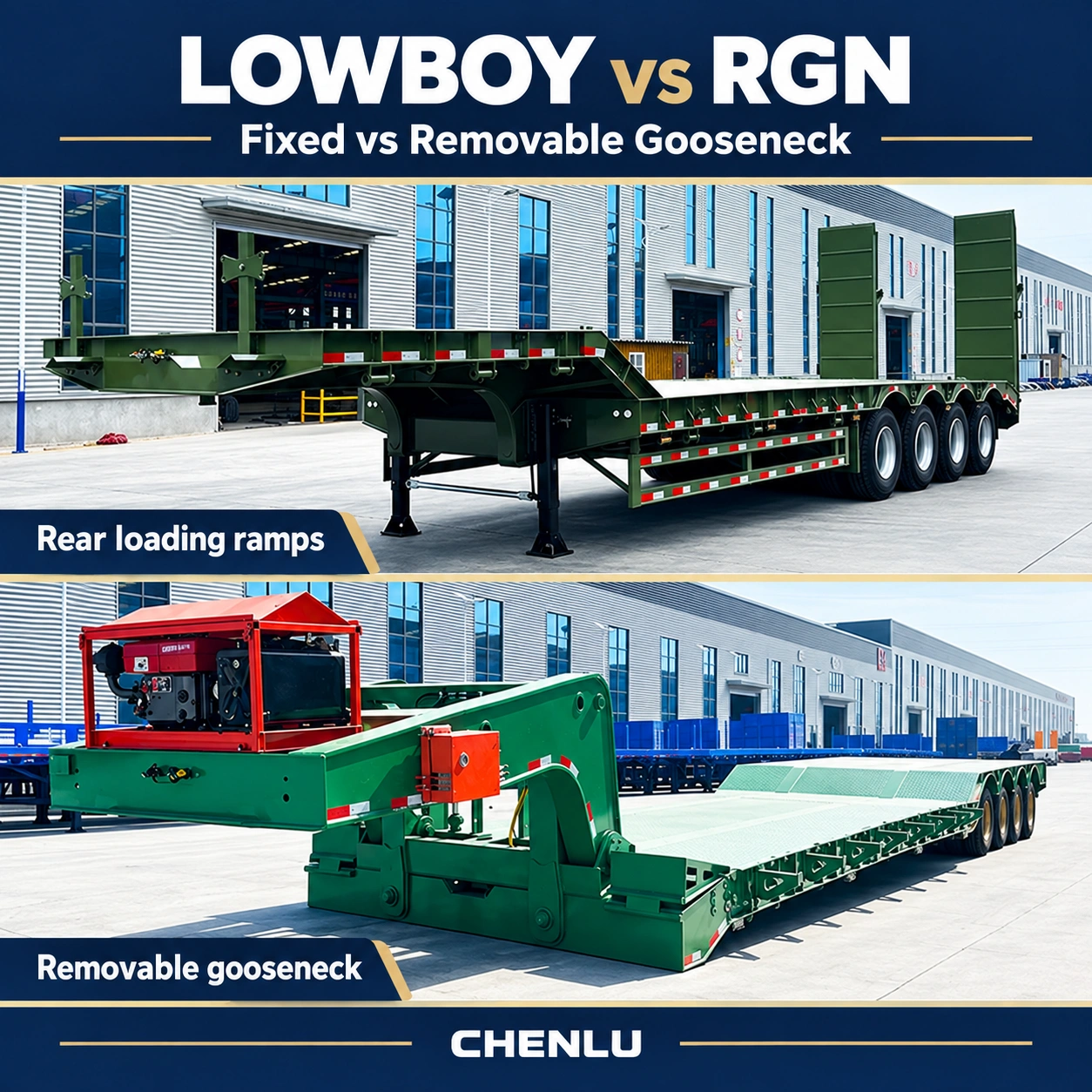
The main difference between a fixed-gooseneck lowboy and an RGN is how equipment reaches the deck. A fixed-gooseneck trailer usually loads over ramps at the rear. An RGN separates the front gooseneck from the main deck, opening a front-loading entrance.
For fleets moving excavators, bulldozers and wheel loaders, this affects whether a machine can get onto the trailer. It also changes the space and work required at each loading site.
What is a lowboy, and how does an RGN fit into the category?
A lowboy trailer is a low-deck semi-trailer used to transport heavy equipment. The gooseneck connects to the tractor, the main deck carries the equipment, and the rear axle group supports part of the load. A lower deck helps control the overall height of the loaded vehicle. Terms such as lowbed, low bed and low-loader also appear in international markets. Regional usage varies, so the layout drawing remains the reference for the actual structure.
RGN stands for Removable Gooseneck. It describes a structure in which the gooseneck can separate from the main deck. An RGN belongs to the lowboy family, although RGN is also commonly used as a distinct trailer name.
A lowboy vs RGN comparison therefore usually concerns two loading arrangements: a fixed gooseneck with rear loading ramps, and a removable gooseneck with front loading. [1]
| Comparison | Fixed-gooseneck rear-loading lowboy | Removable-gooseneck RGN |
|---|---|---|
| Gooseneck and deck | Remain connected during loading and unloading | Can separate for loading, then reconnect |
| Equipment entrance | Over ramps at the rear | From the front of the main deck |
| Main loading transitions | Ramp foot, ramp crest and rear deck transition | Front deck entrance and its transition |
| Working space | Rear space for the ramps and equipment approach | Front space for the gooseneck, tractor and equipment |
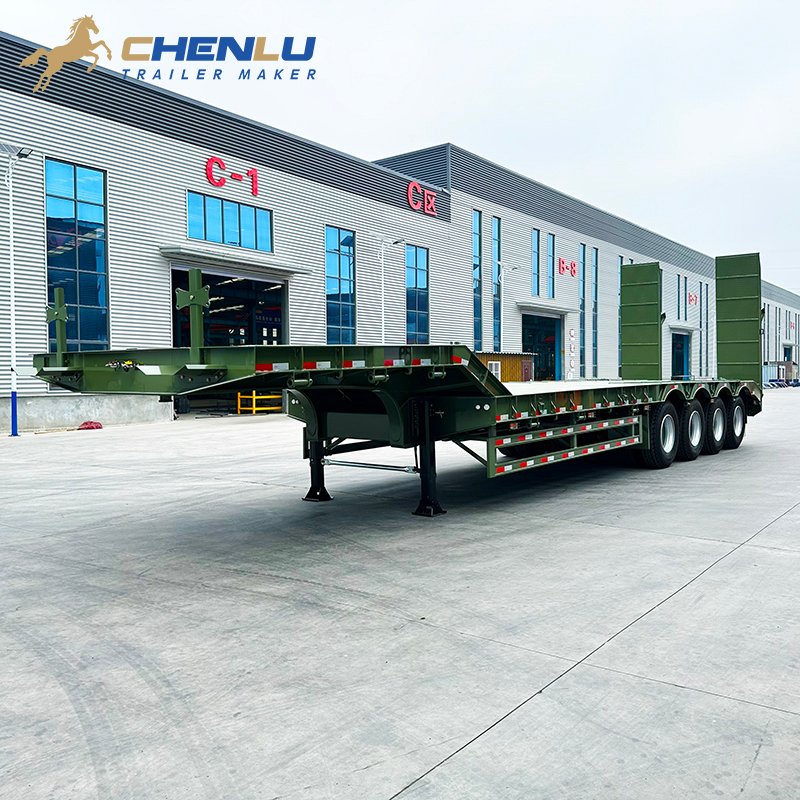
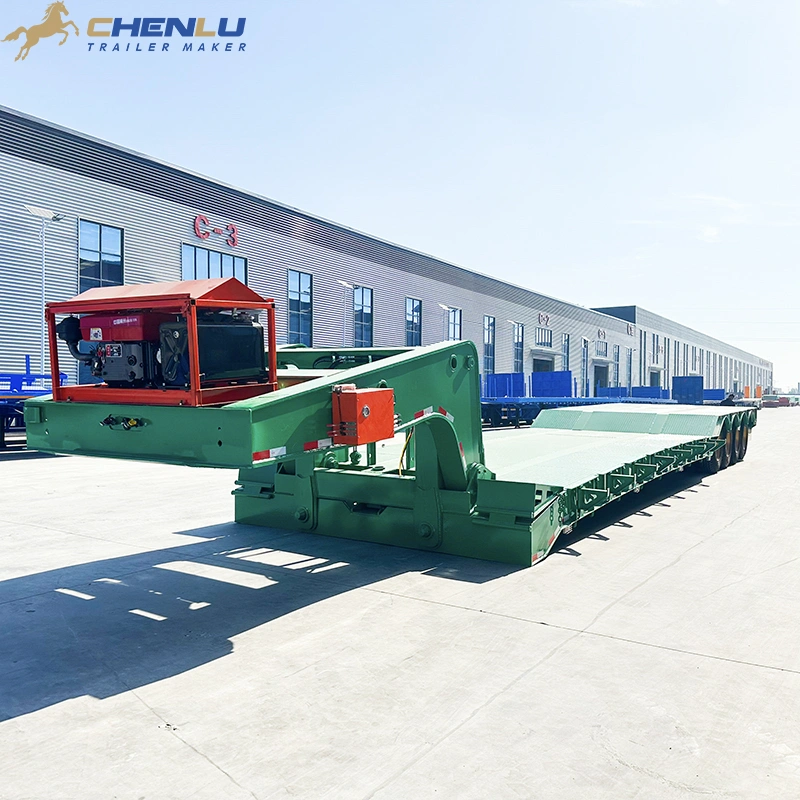
Loading path: rear ramps or front loading?
On a fixed-gooseneck lowboy, the machine climbs the ramps, crosses the ramp crest and rear platform, then reaches its carrying position. Its climbing ability matters, but so does clearance beneath the chassis and attachments at each transition.
A bulldozer's blade projects ahead of its tracks. The blade may approach the ramp surface before the tracks start climbing. At the ramp crest, the track contact positions and machine angle change again. The undercarriage, guards or rear attachments may interfere with the transition. For wheeled equipment, check wheelbase, minimum ground clearance and front and rear overhangs. A machine that can climb the ramp may still be unable to clear its crest.
An RGN changes this path. Once the gooseneck is separated, the front of the main deck is lowered. The machine enters from the front without first crossing the full rear axle platform. [2] Front loading can provide a better approach for equipment with limited underside clearance, long tracks, or blades and rear attachments that restrict its loading angle.
The RGN still has an entrance slope and a front deck edge. Compare the equipment's side profile against each loading arrangement to check whether its lowest parts will contact the frame or approach surface. A removable gooseneck provides front access; it does not guarantee clearance for every machine.
Deck dimensions: is an RGN always lower or longer?
A removable gooseneck allows access at the front, but deck height and length still depend on the configuration. Gooseneck type is not a universal dimensional standard.
Two CHENLU four-axle layout drawings illustrate this. The fixed-gooseneck model with spring-assisted rear ramps shows a deck height of 1,300 mm. [3] The four-axle removable-gooseneck model shows 900 mm. [4] These reference heights differ by 400 mm. That difference matters when assessing loaded height, but it applies to these two configurations, not every fixed-gooseneck and RGN trailer.
If the equipment rests entirely on one deck plane, deck height plus equipment transport height gives a preliminary estimate of overall loaded height. If some support points sit on a higher rear platform, assess the machine's actual position instead. The final check also needs to account for the vehicle's loaded condition and attachment positions.
Deck length needs the same care. Overall trailer length includes the gooseneck and rear structure on both types. It is not the usable equipment support length. Compare where the tracks or wheels will rest, and whether the blade, counterweight or ripper will interfere with either end of the trailer.
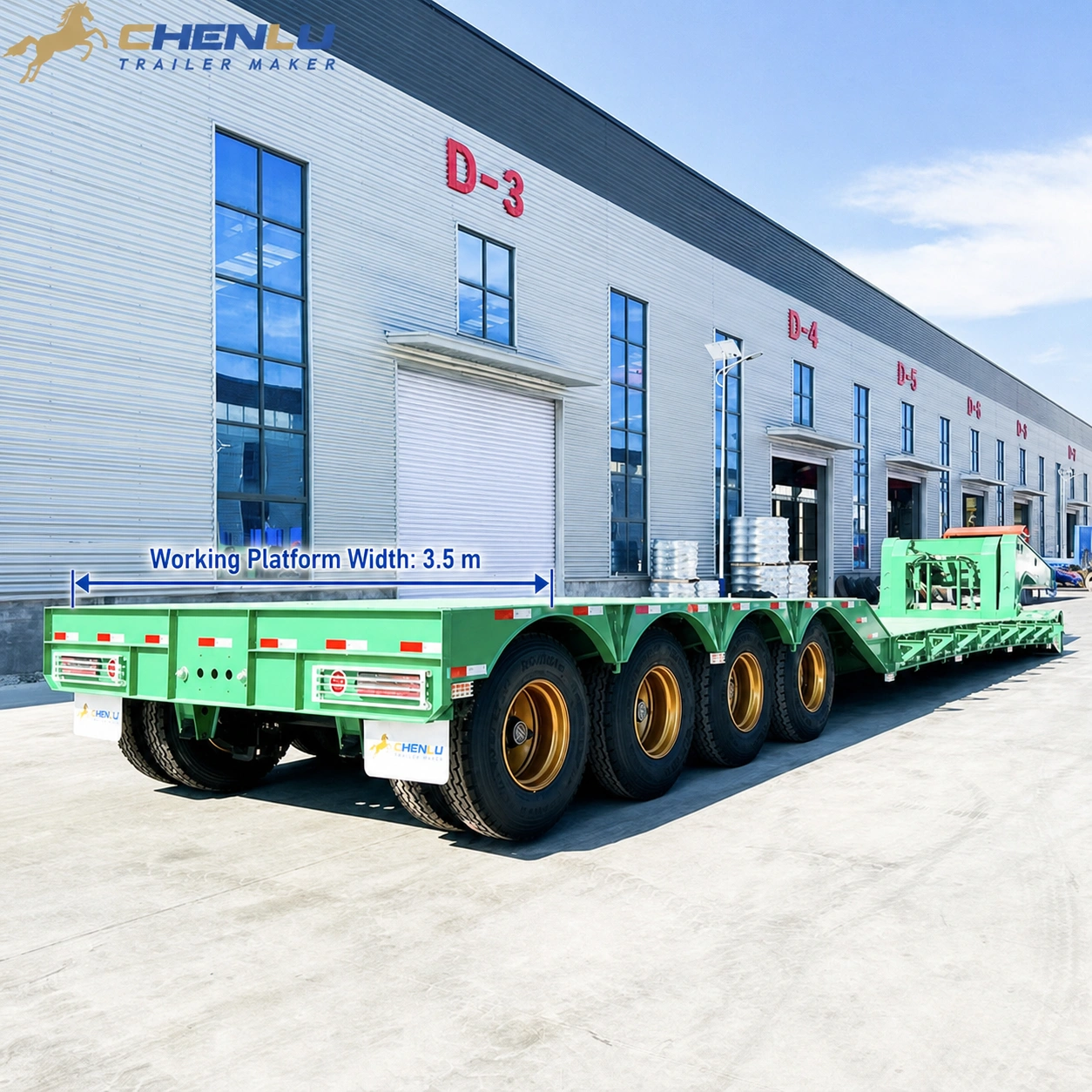
Load capacity: a removable gooseneck does not mean a higher rating
Both a fixed-gooseneck lowboy and an RGN distribute equipment weight between the tractor and the trailer's rear axle group. Moving the equipment changes the load carried through the gooseneck and by the axles. Front loading does not remove the need to calculate that distribution.
Loads of the same weight can impose very different demands on a deck. A long tracked machine bears along an extended area. An industrial component supported on a few small bases concentrates its load over a much shorter area. Total weight alone does not describe the demand on the deck, cross-members or main beams. The manufacturer's distributed and concentrated loading guidelines also relate capacity to the area over which a load is supported. [5]
Compare the two trailer types using the same equipment weight, centre of gravity and support conditions. Then check the frame, gooseneck, tractor fifth wheel and axle-group loads. Axle count or a tonnage in the product name cannot, by itself, confirm suitability for a particular machine.
Site and operation: rear access versus front working space
A fixed-gooseneck trailer needs room behind it to lower the ramps and approach in a straight line. If the equipment clears the rear transitions, there is no gooseneck separation and reconnection to organise during loading.
An RGN needs space ahead of the main deck to separate the gooseneck, move the tractor, bring in the equipment and reconnect. A narrow yard, restricted turning area or soft ground may prevent this sequence, even when the front entrance suits the machine. Talbert's removable-gooseneck operating instructions specify firm, level ground for the relevant operations. [2]
Routine checks differ as well. Rear ramps, hinges and locking points need attention on a fixed-gooseneck trailer. An RGN also requires checks of its gooseneck connections, locks and applicable power system, according to the model. The fixed design avoids a detachable neck mechanism, but its ramps still need maintenance. The RGN provides front access while adding connection and reset checks.
Compare equipment clearance and the full loading process together. Frequent loading makes the choice more significant. Which arrangement is simpler still depends on whether the equipment can load safely from the rear and whether each site supports front loading.
Which should you choose: a fixed-gooseneck lowboy or an RGN?
A fixed-gooseneck lowboy is worth considering first when the equipment can pass the rear ramps and transitions safely, and there is enough space behind the trailer. It keeps the rear-loading process without gooseneck separation.
An RGN is worth considering when the undercarriage or attachments cannot clear the rear transitions, and the site has room for gooseneck operations at the front. Its value is the alternative route it gives that equipment onto the deck.
View configurations in CHENLU's low bed trailer range and removable gooseneck trailer range. Compare both layouts using the same machine's transport profile, support positions and weight to determine which structure fits the work.
Frequently asked questions
Are all RGN trailers hydraulically operated?
No. RGN describes a gooseneck that can separate; it does not specify a hydraulic mechanism. Manufacturer documentation distinguishes mechanical removable goosenecks, hydraulic designs and folding goosenecks. They should not be treated as the same operating arrangement. A hydraulic configuration also requires confirmation of its power source, connections and controls. [6]
Can an RGN load equipment that cannot move under its own power?
Front access changes the loading path; it does not give the equipment a means of movement. Equipment that cannot move under its own power needs a separate loading arrangement on either trailer type, along with suitable support and securement. Whether assisted pulling or lifting is appropriate depends on the equipment's condition and the trailer design.
Does a lower RGN deck mean better road clearance?
A lower deck helps control overall loaded height. Clearance beneath the frame over uneven ground is a separate consideration. Both trailer types require checks of underside ground clearance, axle spacing and vehicle attitude. Site entrances, raised road sections and ferry ramps still need assessment with a removable gooseneck.
About this comparison
This article compares fixed-gooseneck rear-ramp loading with removable-gooseneck front loading. The heights from CHENLU drawings illustrate specific configurations. External manufacturer documents explain general mechanisms, loading concepts and working conditions. Follow the manual supplied with the actual trailer for operating instructions.
References
- ROGERS — Fixed Gooseneck Trailers. Fixed-gooseneck rear-loading layouts.
- Talbert — Trailer Operator's Manual. Chapter 3: gooseneck separation, connection and working conditions.
- CHENLU — Four-Axle Fixed-Gooseneck Lowbed Trailer and Drawing. Deck-height example.
- CHENLU — Four-Axle Removable-Gooseneck Trailer and Drawing. Deck-height example.
- XL Specialized Trailers — Distributed and Concentrated Lowboy Loading Guidelines. Revised 3 April 2025: load distribution and concentrated support.
- E.D. Etnyre — Product Manuals. Manual categories for mechanical removable and folding designs.
MORE FROM OUR NEWSROOM
Related News
Container Chassis vs Flatbed: Choosing for Your Loads | CHENLU
Compare container chassis an…
Read News ↗
Cement Tanker Unloading: Air Supply & Silo Matching | CHENLU
Check cement tanker unloadin…
Read News ↗
CHENLU Studies East Africa’s Semi-Trailer Market and Manufacturing
From September 10–22, 2026, …
Read News ↗
CHENLU Participates in GCC Vehicle Inspection for Saudi Arabia Semi-Trailer Export Projects
CHENLU joined a technical br…
Read News ↗